

Masters Of Defense

Masters of Defense
Masters of Defense (M.O.D.) was an American knife company specializing in production tactical knives, both folders and fixed blades.
The brand was founded in 1997 by Jim Ray. Before launching the company, Ray spent considerable time thinking about what could set his knives apart in an already crowded market. He knew many of America's leading knife designers, including Allen Elishewitz, Kit Carson, Bud Nealy, Howard Viele and Chris Reeve. He could have taken the conventional route and brought an established knifemaker into the company, but that seemed far too predictable.
Jim Ray chose a different approach. He decided that every tactical knife should be developed together with the people who would actually use it — combat instructors and military personnel. Hence the name Masters of Defense.
One of the first people invited to join the company was Jim “Patches” Watson, a legendary Navy SEAL who had received sixteen combat decorations and medals, including four Bronze Stars for valor. Watson had served on three missions in Vietnam and had also fought in Cambodia. Naturally, someone with that level of experience was interested in something more than an ordinary tactical knife: he wanted a hard-use tool designed for special operations.
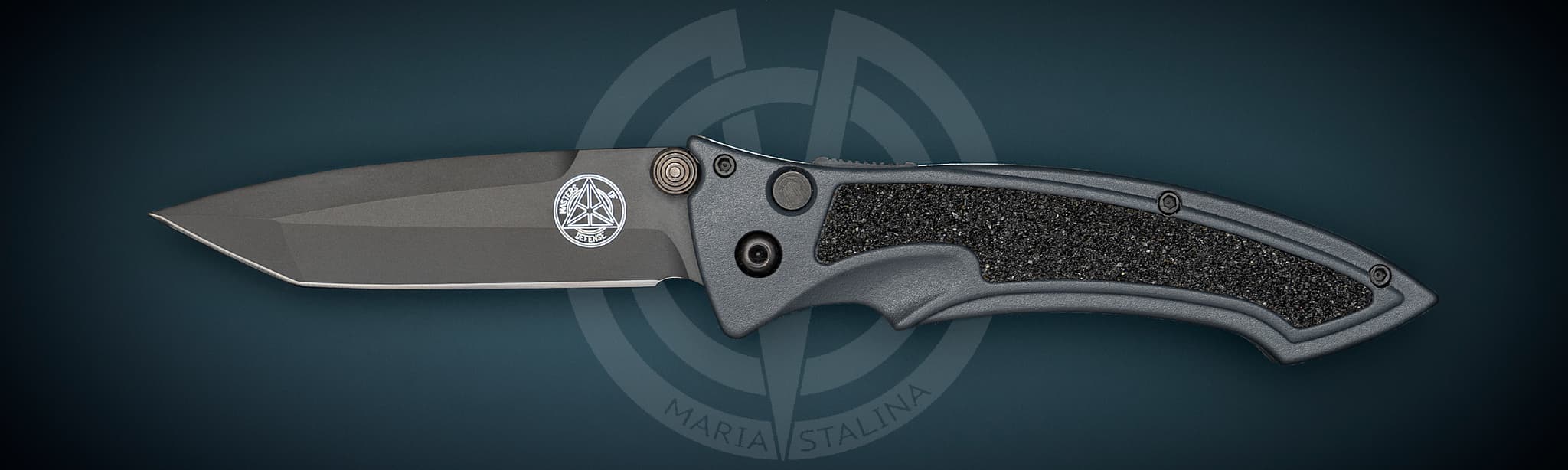
The result was the Trident folder. Its blade featured a modified spear-point profile, with serrations covering roughly one-third of the cutting edge. The blade received a non-reflective black finish, while a series of aggressive grooves on the handle provided a secure grip. The knife opened via a thumb stud and locked with a liner lock. The Trident was built to meet Mil-Spec requirements established by the US Department of Defense.
The Trident was well received by both professionals and knife enthusiasts. Jim Ray realized that his strategy of working with experienced practitioners was paying off, and brought several more experts on board. M.O.D. knives were subsequently developed with martial arts instructor Michael Janich, police trainer Massad Ayoob, black-belt holder Graciela Casillas, and James Keating, founder of the Riddle-of-Steel knife-fighting system.
None of them had previously designed knives. Ray used the same approach that had worked so well with the creator of the Trident: each expert was simply given a blank sheet of paper and asked to sketch the practical knife they would most want for self-defense. To Ray's delight, the designs looked nothing alike — and bore little resemblance to anything already offered by competitors.
Professional knifemakers then turned the sketches into working designs and put them into production. Just one year after the company was founded, M.O.D. presented five models at the 1998 SHOT Show: four folders and one fixed blade — the Ayoob Razorback, Janich Tempest, Casillas Hawk, Keating Hornet and Watson Trident. All featured high-quality 154CM steel blades and machined T6 aircraft-aluminum handles. The knives attracted considerable attention at the show.
Another legendary military instructor soon joined Jim Ray's roster of collaborators: Duane Dieter, whose training programs had been adopted by several police departments and the US Navy SEALs. Their collaboration produced the Dieter CQD Mark I, which became another major success for the company. This dagger-like folder used the same materials as its predecessors and featured a Plunge-Lock, a cord-cutting hook and specially treated handle scales for improved grip. The CQD Mark I caused a sensation at the 2000 Blade Show, where it was named “Knife of the Year”.
During its brief six-year history, M.O.D. produced a number of other notable tactical knives. The original Mark was followed by the smaller Mark II, while the MOD LTT 875 became another particularly popular model. Almost every design was offered in several variations, differing in blade finish and profile as well as locking mechanism.
Masters of Defense's rapid rise came to an end in 2003, when the company was acquired by tactical equipment manufacturer BLACKHAWK! Products Group. The company, known for producing tactical gear such as elbow pads and gloves, wanted to expand into tactical knives. Some of the famous M.O.D. models can still be found today under the BLACKHAWK! name, although their materials and construction differ from the original versions.