

Martin Peter

Peter Martin
Had the hand saw never been invented, the world of custom knifemaking might have lost one of its most remarkable craftsmen. Peter Martin's journey began with a broken piece of a saw blade — the same unlikely starting point that inspired makers such as Fabrizio Silvestrelli and Sergey Shirogorov.
As a boy, Peter Martin fashioned his very first fixed-blade knife from that fragment, with his father helping him shape the steel and fit the handle. Once the knife was finished, Peter proudly put it to work, cutting everything he could find before eventually using it for throwing practice. Unsurprisingly, the homemade knife didn't survive for long — but the passion it sparked never faded.
Years later, after finishing school, Peter became a truck driver while pursuing another lifelong passion: hunting, a common pastime in his hometown of Waterford, Wisconsin. Wanting a hunting knife worthy of the outdoors, he commissioned a custom maker to build a simple fixed blade with an O-1 tool steel blade, a Micarta handle, and a traditional leather sheath.
At the time, O-1 was one of the most respected knife steels in America. During the 1970s, it was widely used for custom knives thanks to its ability to reach around 60 HRC, excellent toughness, long-lasting edge retention, and affordable cost — despite requiring regular care to prevent corrosion.
The finished knife exceeded every expectation. So impressed was Peter that he persuaded the maker to let him spend a day in the workshop. That single day changed everything. In 1987, Peter began making knives of his own. His earliest work consisted of rugged but highly functional hunting knives, and within a year he had sold his first piece.
Initially, Martin purchased blades from other makers, but by 1989 he had begun learning the art of forging. He started as an observer in a local blacksmith's shop before becoming an apprentice, later studying with renowned masters including Howard Clark, Jim Miller, and R.B. Johnson. By 1992, he was forging and pattern-welding his own Damascus steel. It wasn't long before he mastered the art of coloring Damascus through controlled oxidation — a technique that would become one of his signatures.
Another milestone came in 1994, when Martin expanded into folding knives. Within a remarkably short time, he mastered mechanisms including Frame Lock, Liner Lock, Slipjoint, assisted opening systems, and automatic knives. His greatest mechanical achievements came in the form of his celebrated “Bug Knives”. Resembling spiders, dragonflies, butterflies, or praying mantises, these intricate folders earned numerous awards and eventually gave Martin the nickname “The Bug Man”.
For many years, Peter balanced knifemaking with his career as a truck driver. It wasn't until 2003 that he committed himself entirely to making knives. Looking at his highly artistic creations today, it is hard to imagine they were designed by someone who once spent his days behind the wheel of a truck.
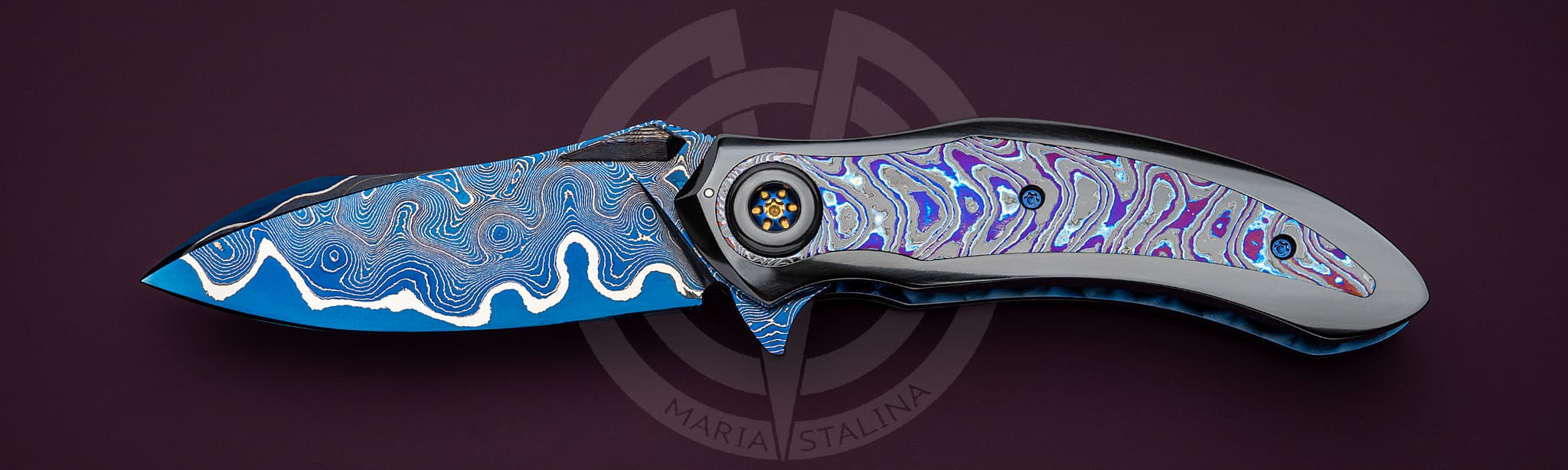
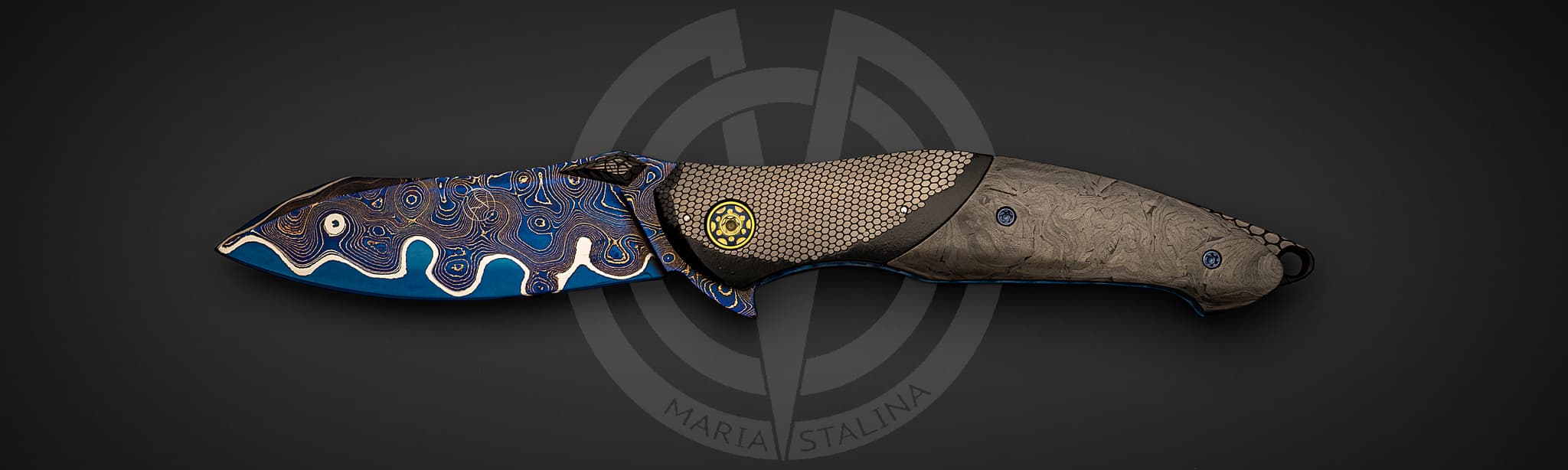
Martin's art folders are celebrated for their vibrant mosaic Damascus, precious metals, gemstones, and exceptional finishing. He has a particular affinity for natural materials, often incorporating mother-of-pearl, rare hardwoods, or even exotic materials such as oryx horn and bear jawbone into his fixed-blade knives. Another memorable series draws inspiration from steampunk, pairing Damascus blades with handles decorated using antique watch movements.
Modern materials also play an important role in Martin's work. One of his most striking creations is the Nebula flipper, featuring a handle crafted from marble carbon fiber and the extraordinary SuperCon composite. The bolster, pocket clip, backspacer, and thumb stud are all made from SuperCon, complementing a beautifully forged Damascus blade.
For more than three decades, Peter Martin has created knives that blur the line between functional tools and fine jewelry. Today, his legacy continues through his son, Cory Martin, who has followed in his father's footsteps while developing a style of his own. Cory focuses exclusively on flippers, preserving the family's exceptional craftsmanship while introducing a stronger tactical influence to his designs.
For collectors who appreciate handcrafted Damascus knives, Peter Martin's work represents the perfect balance of technical mastery, artistic vision, and uncompromising craftsmanship.