

Revishvili Zaza
Zaza Revishvili
The first Soviet knifemaker to gain recognition in the West, a founding figure of Russian knifemaking, and a master of the ancient art of filigree &mdash: all these titles belong to Zaza Revishvili.
Zaza Revishvili was born in the ancient city of Tbilisi, the capital of Georgia. The question «How old were you when you first became interested in knives?” would probably make Zaza laugh, as it would many Georgians. In the Caucasus, a dagger has traditionally been part of a man's life from the very beginning. Following centuries-old tradition, a boy could receive his first knife as a gift at birth.
Revishvili was fascinated by the work of jeweler-armourers, but initially chose a different profession for himself. As a young man, he dreamed of designing buildings and, immediately after school, enrolled in the architecture department of the Tbilisi State Academy of Arts.
He enjoyed studying architectural design and structural engineering, wrestling with higher mathematics and mechanics, but what fascinated him most was art theory and drawing. During his studies, Zaza acquired his first practical experience working with metals and mastered the art of filigree — creating intricate patterns by soldering fine metal wires together. He soon began applying these skills to knife decoration.
Revishvili graduated in 1986, at a time when the economic crisis in the Soviet Union was already gathering pace. Much of the money that still circulated in the country was concentrated in Moscow, and finding work in the Soviet capital was easier. Zaza decided to leave the cozy streets of his beloved Tbilisi and try his luck in Russia.
In Moscow, he found work as an interior designer while continuing to develop his jewelry-making and knifemaking skills in his spare time. It was during this period that his unique artistic style began to emerge.
As early as 1987, Zaza Revishvili exhibited his first works. His early knives drew heavily on the traditions of his native Georgia. They were fixed-blade daggers, most of them kamas, with handles richly decorated with filigree and gemstone inlays in the finest Caucasian tradition.
Revishvili—s work was highly praised by both admirers of knife art and his fellow makers. It took him only a couple of years to establish himself as a recognized master.
The term “knifemaking”, however, was not yet part of his vocabulary. Zaza encountered it a little later, when he began exhibiting at knife shows abroad.
In 1991, Revishvili presented his work to a Western audience for the first time, taking part in a knife exhibition in Munich. As the only participant from the Soviet Union, he immediately attracted considerable attention.
The Iron Curtain had already begun to rust, but it had not yet fallen. Europeans eagerly peered through the gaps, fascinated by the opportunity to meet these exotic representatives of “the other side”. Some visitors initially approached Revishvili hoping to hear firsthand news from someone who had witnessed the collapse of the Soviet empire. They left, however, having forgotten all about politics and captivated instead by the extraordinary craftsmanship of the Georgian knifemaker.
Munich opened the door for Zaza to the seemingly endless world of custom knifemaking. He asked fellow makers which other knife shows were worth attending and embarked on a kind of global tour.
Atlanta, Paris, San Francisco, Milan, New York — wherever Zaza Revishvili exhibited his knives, his work attracted enormous attention and sold with remarkable speed.
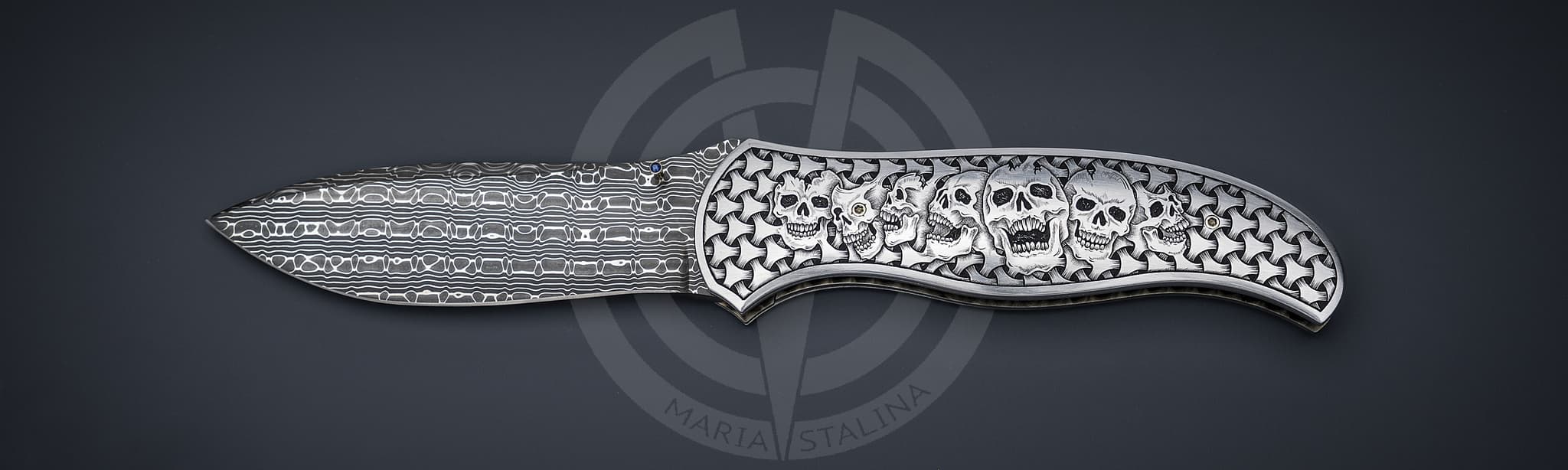
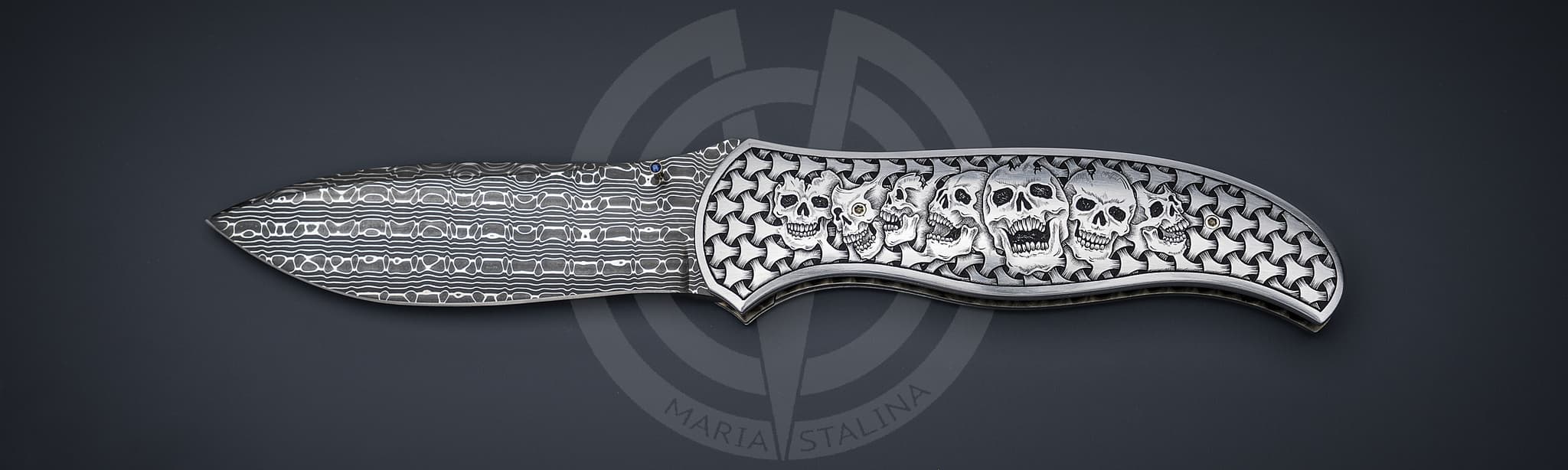
The Georgian maker was equally impressed by the skill of his international colleagues. Inspired by their work, Revishvili added folders to his repertoire, began experimenting with different locking mechanisms, and expanded his approach to handle decoration.
Only one thing remained unchanged: his choice of blade material. The master categorically refused to work with anything other than Damascus steel.
In 1995, Zaza Revishvili made a life-changing decision: he emigrated to the United States. One armed conflict followed another in his native Georgia, while Russia was struggling through economic turmoil. In the United States, meanwhile, his work was already highly sought after, and the custom knifemaking scene was developing at an extraordinary pace.
Revishvili moved to Madison, Wisconsin, where he bought a house and built his own workshop.
The future proved that the Georgian master had made the right choice. Zaza Revishvili still lives and works in Madison. American custom-knife enthusiasts regard him as a living legend, while his magnificent daggers and exceptional folders have found their way into some of the world—s finest collections, including royal collections and the Armoury Chamber of the Moscow Kremlin.